A company can sell more chips and still earn less from them. That is the uncomfortable possibility behind today’s Micron debate. AI demand can keep expanding while competition weakens the profits investors expect. For shareholders, those two forces can pull in opposite directions.
- Micron led ApeWisdom’s live WallStreetBets mention ranking when checked today, as Chinese competition put memory stocks under pressure.
- The investment risk is losing pricing power, even if demand for AI infrastructure continues growing.
- CXMT’s server-memory plans deserve attention. Their impact depends on production scale, customer acceptance and the products they actually challenge.
The stock at the centre of the argument
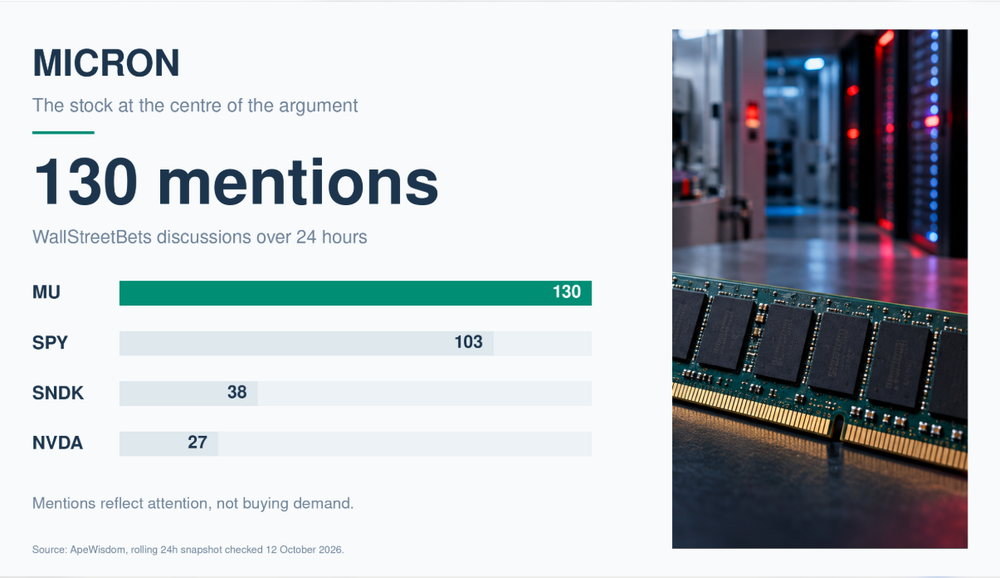
In the snapshot checked today, ApeWisdom counted 130 Micron mentions across its rolling 24-hour WallStreetBets sample. SPY followed with 103, while Sandisk registered 38 and Nvidia 27. These counts measure discussion, including bearish comments, rather than buying demand.
The immediate catalyst was competition from China’s ChangXin Memory Technologies, known as CXMT.
Reports described progress on a denser DRAM design, with a server-memory product targeted for the end of 2026. Micron fell more than 4% in early Monday trading, according to Investor’s Business Daily.
The reaction followed an extraordinary rally. Reuters reported that Micron and Sandisk had both more than tripled this year.
That makes the debate especially relevant to investors considering the dip. A stock can fall sharply and still carry demanding expectations.
The next step is to identify which expectation this news challenges.
China is challenging the price of scarcity
The appeal of the memory trade is straightforward. AI systems need memory, and suppliers can earn attractive profits when customers compete for limited supply.
CXMT is trying to change that balance.
Its latest plans concern server DRAM. Separately, the company announced mass production of its fifth-generation DRAM platform in September.
CXMT said that platform produced at least 50% more gross dies per wafer than its predecessor, using a normalized comparison. Its announced products served smartphones and portable electronics.
That earlier platform announcement is separate from the new server-memory development. Combining them would exaggerate what CXMT has already delivered.
But the direction matters: a competitor is seeking to make more memory from its manufacturing capacity.
If those gains translate into reliable commercial supply, buyers could gain more bargaining power.
That is the financial threat worth examining. Demand does not need to disappear for a supplier’s selling prices to come under pressure.
Micron’s results reveal what is at stake
Micron’s latest results show why investors became excited.
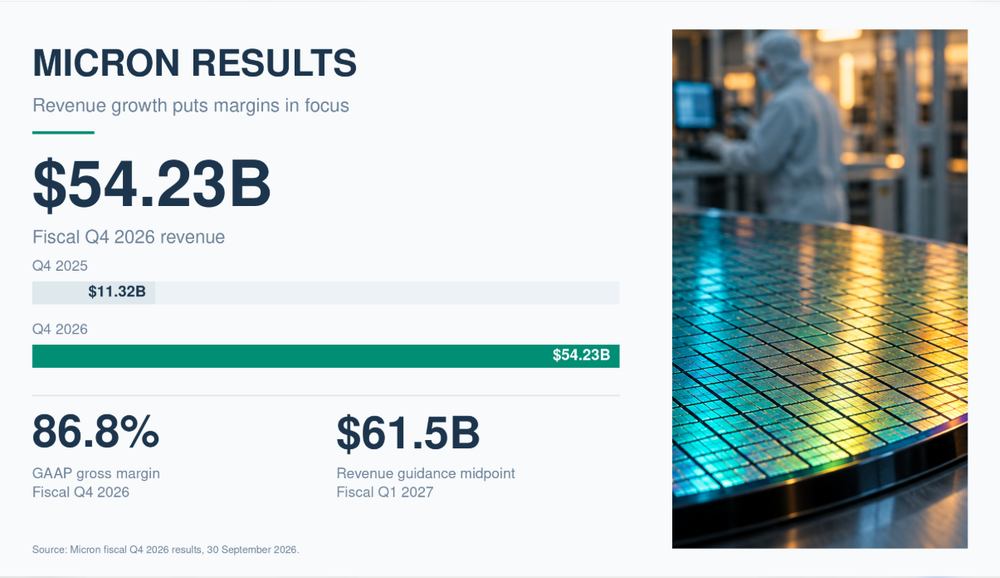
Fiscal fourth-quarter revenue reached $54.23 billion, compared with $11.32 billion a year earlier. Its reported gross margin reached 86.8%.
For fiscal first-quarter 2027, management guided to revenue of $61.5 billion, with a $1.5 billion range either side. It projected a gross margin of approximately 85.95% under standard accounting rules.
Those figures describe exceptional profitability. They also make the durability of that profitability central to the investment case.
Consider a hypothetical example using the reported margin as a starting point.
A business generating $100 of revenue at an 86.8% gross margin earns $86.80 of gross profit. Suppose revenue then grows 20%, while its gross margin falls to 70%.
It would generate $120 of revenue but only $84 of gross profit. Sales would rise, while gross profit would fall roughly 3%.
This is an illustration, not a Micron forecast. It shows why revenue growth alone cannot settle the argument.
A growing AI market does not guarantee growing profits for every company supplying it.
A lower share price therefore needs to be assessed against earnings that can last, rather than the strongest quarter.
The distinction that changes the investment case
A bullish thread in r/MU_Stock argues that Micron’s shift toward AI memory reduces its exposure to CXMT.
That claim depends on distinguishing the products.
Server DRAM and high-bandwidth memory perform different jobs. Micron describes HBM as specialized memory built from vertically stacked chips for demanding computing workloads.
CXMT’s reported year-end target concerns a DDR5 server-memory product. It does not establish that the company can replace Micron’s HBM offerings across AI systems.
That distinction cuts both ways.
Bears should avoid treating every memory breakthrough as an immediate threat to every product. Bulls should avoid assuming that exposure to HBM protects the rest of Micron’s business.
Micron also sells other memory and storage products. Its earnings depend on the combined performance of those businesses.
Sandisk requires a separate analysis, too. Its business centres on flash storage, including NAND technology, rather than the same server-DRAM product CXMT is discussing.
A shared sell-off can reflect shared investor concerns. It does not prove identical competitive exposure.
The useful question is where new supply could weaken prices, and how much each company’s earnings depend on that market.
Three signals that would change the assessment
First, commercial delivery. Watch whether CXMT meets its announced server-product timetable and reports meaningful shipments.
A launch establishes progress. Sustained volumes and customer acceptance would provide stronger evidence of competitive pressure.
Second, pricing and margins. Track Micron’s comments on selling prices alongside its reported gross margins.
A margin decline needs explanation. Product mix, manufacturing costs and competition can affect the same headline figure in different ways.
Third, customer commitments. Look for evidence that demand converts into orders with durable economics.
Large spending plans attract attention. Their value to suppliers depends on delivery schedules, prices and the strength of those commitments.
These signals connect the technology announcement to the earnings investors are paying for. They also provide a way to reassess the thesis without following every intraday move.

What this means for buying the dip
Today’s news raises a competitive question that one trading session cannot resolve.
An attractive entry would require confidence that Micron’s future profits justify its valuation after allowing for greater supply. Evidence of stable pricing and defensible products would strengthen that case.
Evidence of expanding rival shipments and weakening margins would make the apparent discount less persuasive.
The same approach applies across the AI supply chain. Identify the scarce component, then examine how long its supplier can keep earning exceptional returns.
AI can become more successful while some of its inputs become less profitable to sell.

Marc has been involved in the Stock Market Media Industry for the last +5 years. After obtaining a college degree in engineering in France, he moved to Canada, where he created Money,eh?, a personal finance website.