SpaceX poured $15.8 billion into its AI division in the second quarter. That investment now exposes shareholders to a threat arriving from China’s memory industry.
On Tuesday, SpaceX traded at $157.51, down 3.6%, as memory stocks sold off. Samsung fell 7.4% in South Korea, while SK Hynix lost 10.1%.
Cheaper memory should help companies building data centers. But it could also make competing compute services cheaper to build.
For SpaceX shareholders, the risk is that lower construction costs arrive alongside weaker pricing power. Its quarterly accounts show why that tradeoff matters.
- AI absorbed 86% of SpaceX’s quarterly capital spending and generated 33% of revenue.
- China’s memory advance threatens expected profits before its commercial impact is established.
- Connectivity’s operating profit provides support, while AI must prove its return on investment.
The announcement threatens future pricing power
On October 10, CXMT outlined its new 4F² memory architecture at an industry conference in Shanghai. It plans to introduce DDR5 server-memory products using that design before year-end.
The aim is to fit more memory cells into a given area. That could improve manufacturing economics, provided the technology reaches reliable production.
The financial attraction is straightforward: more supply could weaken the pricing power of established memory suppliers.
But a launch target leaves several tests ahead. Customers need reliable products, manufacturers need acceptable yields, and shipments must become large enough to affect prices.
There is also evidence that the market remains tight.
On September 30, TrendForce forecast 10-15% quarterly growth in conventional DRAM contract prices during Q4. It also expected server DRAM to remain undersupplied. That forecast predates CXMT’s October announcement.
The selloff appears to anticipate future competition, rather than reflect an established collapse in memory prices.
That distinction matters when deciding whether a falling stock has become attractive.
SpaceX investment budget explains the connection
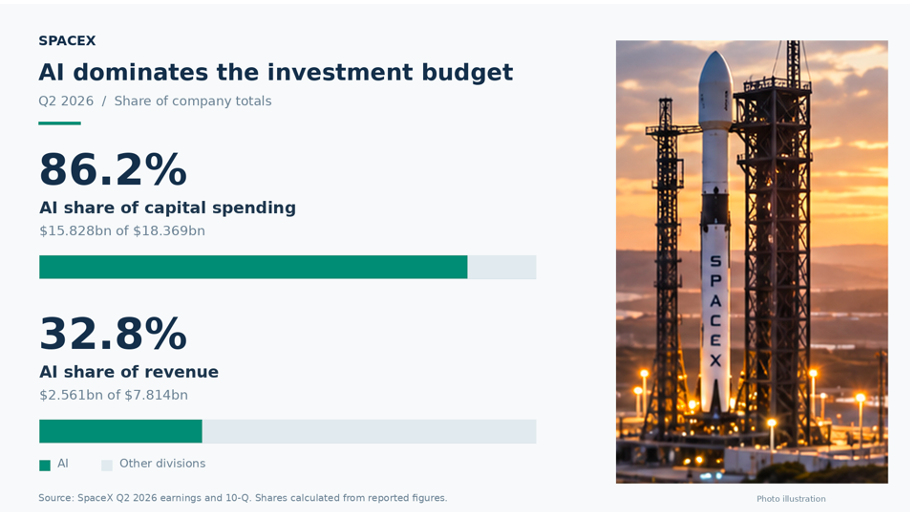
AI accounts for 86.2% of capital spending and 32.8% of revenue in Q2 2026. Source: SpaceX.
SpaceX’s second-quarter revenue reached $7.81 billion, up 92% from a year earlier. Its three divisions carried very different financial responsibilities.
Company figures. Capital spending purchases assets used over multiple years.
| Q2 2026 division | Revenue | Operating profit or loss | Capital spending |
| Connectivity, including Starlink | $4.291bn | +$1.656bn | $1.367bn |
| AI | $2.561bn | -$1.257bn | $15.828bn |
| Space | $0.962bn | -$0.542bn | $1.174bn |
| Total | $7.814bn | -$0.143bn | $18.369bn |
Calculating from those figures, AI absorbed 86% of capital spending and supplied 33% of revenue.
Connectivity generated approximately 55% of revenue, with an operating margin near 38.6%.
The company’s profitable connectivity business therefore sits alongside a much larger AI investment program.
That gives SpaceX two different exposures to cheaper hardware.
Lower memory costs could reduce the expense of adding computing capacity. If rivals receive similar savings, they could expand faster and compete harder for customers.
Our assessment: SpaceX benefits most if its hardware costs fall while its customers keep paying attractive compute prices.
Revenue growth alone cannot establish whether that combination will hold.
Micron shows how much pricing power is at stake
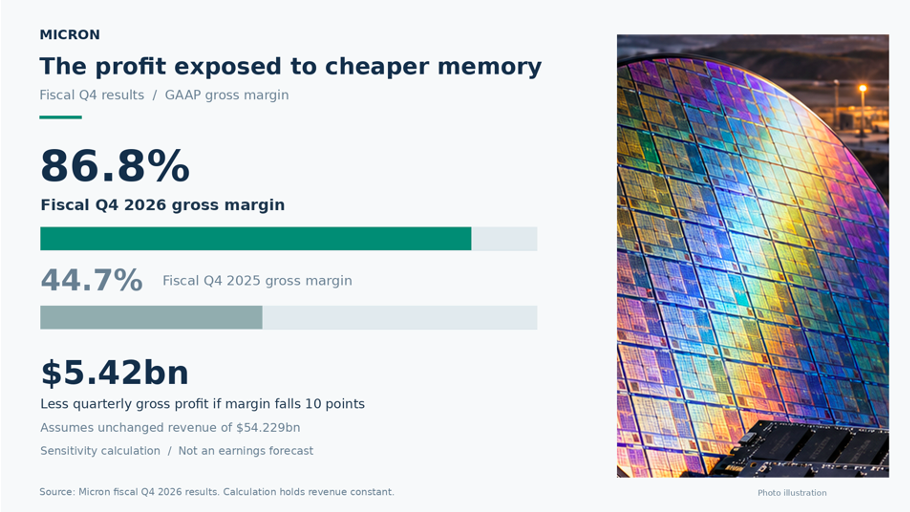
Reported GAAP margins and a calculation at unchanged sales. Source: Micron fiscal Q4 2026 results.
Micron’s latest results explain why investors react sharply to potential new supply.
Fiscal fourth-quarter revenue reached $54.23 billion, compared with $11.32 billion a year earlier. Its GAAP gross margin reached 86.8%, versus 44.7% in the comparable quarter.
Those figures show how profitable the current memory market has become. They also make the durability of margins central to valuation.
Consider a simple sensitivity calculation.
At unchanged quarterly revenue, a 10 percentage-point reduction in gross margin would remove approximately $5.42 billion in gross profit.
That calculation holds sales constant and excludes changes in operating expenses, taxes and product mix. It illustrates exposure; it is not an earnings forecast.
SpaceX faces a related challenge from the customer side.
Its expanding compute business must earn enough from customers to justify equipment spending. Competition that lowers hardware costs could also lower the prices those customers accept.
The cash gap deserves more attention than the daily chart
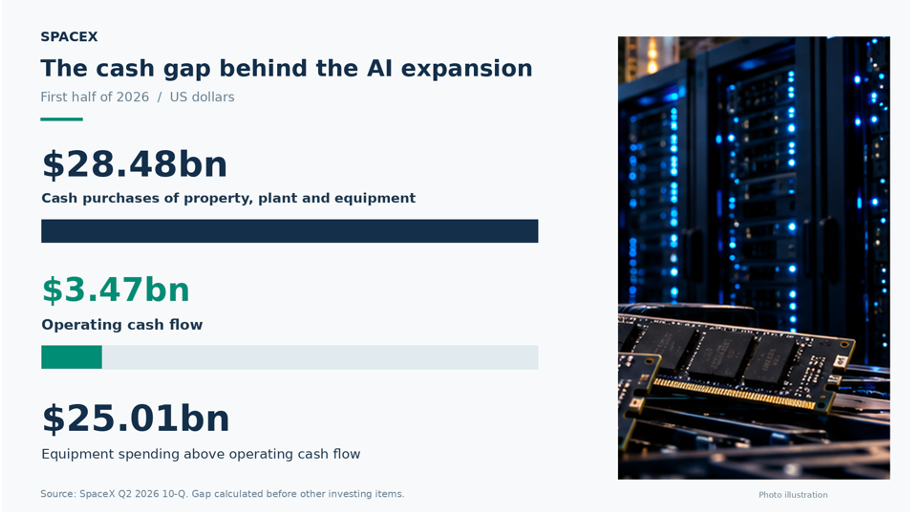
First-half operating cash flow compared with cash equipment purchases. Source: SpaceX Q2 2026 10-Q.
Across the first half, SpaceX generated $3.47 billion in operating cash flow. Cash purchases of property, plant and equipment reached $28.48 billion.
Subtracting those equipment purchases from operating cash flow leaves a $25.01 billion gap, before other investment items.
That gap requires funding while the assets mature.
SpaceX ended June with approximately $100 billion in cash, cash equivalents and marketable securities. It has substantial financial capacity, although that balance is a June snapshot.
The Financial Times subsequently reported plans for $40 billion in additional borrowing to purchase Nvidia chips. It also reported five-year credit-default-swap spreads widening from 110 to 194 basis points.
Those spreads measure the price of credit protection. Their increase suggests lenders and credit investors are demanding more compensation for risk.
Borrowing lets investment proceed before the resulting cash flows arrive. It also makes the eventual return on that equipment more important.
A lower share price still carries demanding expectations
At Tuesday’s price snapshot, SpaceX’s reported market value was approximately $2.14 trillion. Shares were around 30% below their $225.64 high.
Using that market value, the stock traded around 68 times second-quarter revenue annualized.
This calculation multiplies quarterly sales by four. It assumes identical quarters and serves as a comparison, rather than a revenue forecast.
The average analyst target was $221.26, approximately 40.5% above the snapshot price. That is a published estimate, with assumptions about future performance.
For a new investment, I would want the next results to answer three specific questions:
- AI returns: Improving operating performance with slower growth in capital spending.
- Starlink resilience: Connectivity margins holding near Q2’s 38.6%.
- Cash conversion: Operating cash flow covering a greater share of equipment spending.
Strong answers would give the valuation firmer support. Deteriorating answers would make the headline growth rate less persuasive.
I would wait for clearer cash conversion before calling this selloff a bargain.
SpaceX’s next challenge is to turn its enormous AI investment into cash that shareholders can measure.
The investment case strengthens when revenue growth comes with better returns on the money already spent.
Disclosure: This article provides financial information and analysis, not personalized investment advice.

Marc has been involved in the Stock Market Media Industry for the last +5 years. After obtaining a college degree in engineering in France, he moved to Canada, where he created Money,eh?, a personal finance website.