Sekur’s international expansion is entering a more concrete phase.
Portuguese arrived on September 22. French followed on October 13. Both launches prepare the company for sales abroad. [1][2]
The investment angle starts with scale. At the October 13 reference quote of US$0.0247, Sekur’s indicated equity value is approximately US$6.4 million. That calculation uses the 259.6 million shares reported at June 30. [3][4]
At that size, hundreds of premium subscriptions could materially change the revenue base. Successful contracts could give investors a different business to value.
- Two new sales routes: Portuguese supports Angola and Mozambique; French supports the DRC, Switzerland, and other francophone markets.
- A small customer count can matter: 500 premium SekurOne subscriptions at management’s announced price would generate US$1.8 million annually.
- The upside depends on execution: Our 5× revenue illustration gives 1,000 subscriptions about 108% potential upside with 350 million shares.
Two Launches, Two Sales Routes
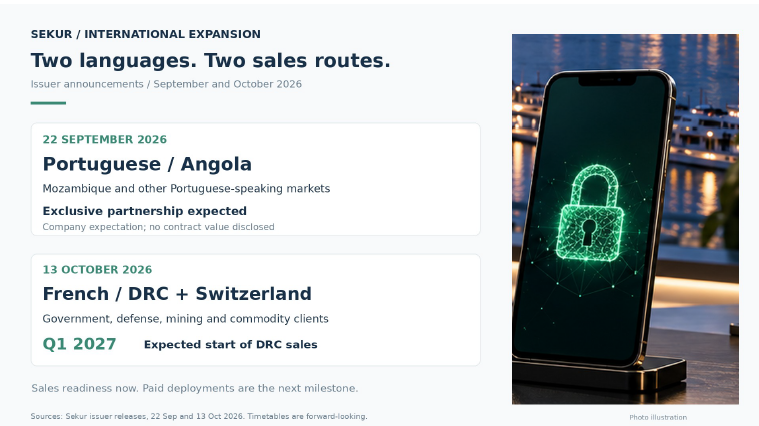
The September 22 release introduced Sekur.com in Portuguese, following the earlier Spanish addition.
Sekur also described translating its workflows and onboarding for upcoming partners. That matters when customers must adopt unfamiliar communications software.
Angola is the immediate focus. Management said it expected an exclusive partnership in the coming weeks.
Mozambique and other Portuguese-speaking markets provide additional expansion possibilities. The release announced preparation for these markets, without assigning revenue to them. [1]
The October 13 release added French, the third additional language after Spanish and Portuguese.
This announcement provides a clearer timetable. Sekur says it already has a team in the Democratic Republic of the Congo. It expects sales there to begin in Q1 2027.
Its intended customers include government, defense, mining, and commodity organizations.
Switzerland offers another route. The release highlights Geneva’s commodity traders, family offices, and wealth managers. It also names Morocco, Algeria, and Côte d’Ivoire as potential francophone markets. [2]
These groups handle confidential negotiations, financial information, and operational communications. My investment inference is that these needs could support premium subscriptions.
French could help the same sales effort reach several customer groups. Portuguese could support local distribution in Angola.
Neither release discloses a signed customer order, contract value, or paid license count. The commercial opportunity remains prospective. [1][2]
A Small Revenue Base Makes New Sales Meaningful
Sekur’s first-half numbers show why international traction could matter.
Revenue reached C$185,828, against C$251,609 a year earlier. That represents a 26.1% decline.
The United States contributed C$182,363. The rest of the world contributed just C$3,465.
In other words, approximately 98.1% of reported revenue came from the United States. International sales represented only 1.9%. [3]
The new languages address a largely undeveloped revenue stream. Even modest overseas sales could change that geographic mix.
However, the company’s transition still needs to produce growth. A translated website supports distribution; investors eventually need invoices and collections.
Sekur’s September shareholder letter explains the intended shift toward government, defense, intelligence, and executive customers. It also acknowledges falling revenue during the transition from legacy accounts. [5]
The opportunity becomes more interesting when premium pricing enters the calculation.
The Subscription Math Behind the Opportunity
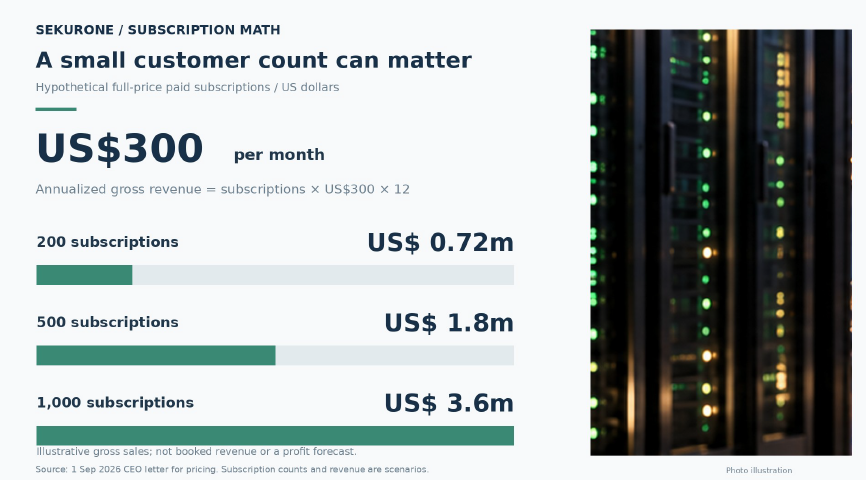
Management’s September letter announced a US$300 monthly commercial price for SekurOne.
At that price, one subscription represents US$3,600 in annualized gross revenue. [5]
The arithmetic scales quickly:
- 200 subscriptions: US$60,000 monthly, or US$720,000 annually.
- 500 subscriptions: US$150,000 monthly, or US$1.8 million annually.
- 1,000 subscriptions: US$300,000 monthly, or US$3.6 million annually.
- 2,000 subscriptions: US$600,000 monthly, or US$7.2 million annually.
These calculations assume paying subscribers remain at the full monthly price for twelve months. They exclude existing revenue.
They also represent premium SekurOne subscriptions. Other products, distributor terms, and bulk agreements could produce different revenue per license.
Management estimated that approximately 200 SekurOne subscribers could bring the company to profitability. That is management’s estimate, rather than a demonstrated break-even result. [5]
For investors, the practical implication is straightforward. Sekur could grow materially without needing a mass-market customer base.
A department, executive group, or several smaller deployments could contribute meaningful license volumes. Whether Sekur can win those buyers remains the central execution question.
What Successful Execution Could Mean Per Share
The following illustration applies 5× annualized subscription revenue directly to equity value. This is our chosen modeling assumption.
It is not a peer-derived valuation, analyst target, or management forecast. No probability or completion date is assigned.
The first price column uses 259.6 million shares, from Sekur’s June filing. The second assumes 350 million shares. [3]
That larger count is a hypothetical dilution case, roughly 35% above the filing figure. It is not the current fully diluted count.
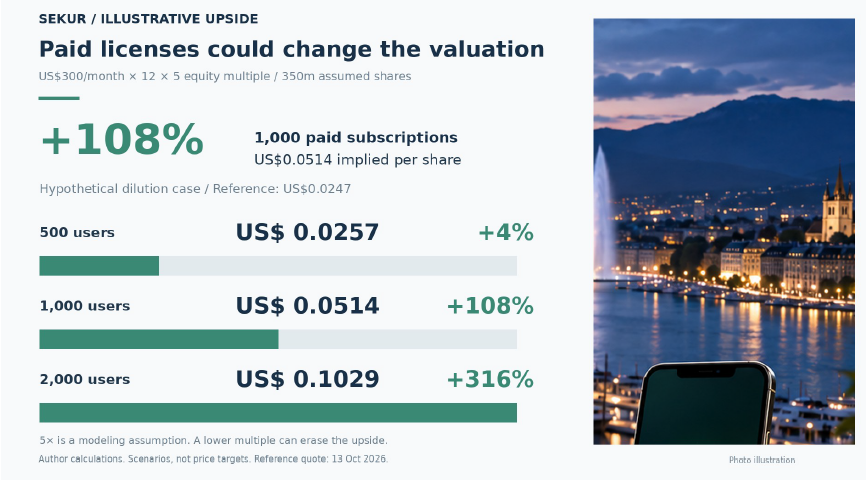
Against the US$0.0247 reference quote, the larger-share-count scenarios imply approximately 4%, 108%, and 316% upside, respectively. [4] The 1,000-subscription example would imply US$18 million of equity value. The 2,000-subscription example would imply US$36 million.
Those outcomes require both recurring sales and the assumed valuation multiple.
The multiple matters sharply. At 2× revenue, 1,000 subscriptions and 350 million shares imply approximately US$0.0206, below the reference quote.
These are sensitivity calculations. They exclude financing proceeds and balance-sheet adjustments, and assume the modeled revenue belongs to Sekur.
The releases establish potential sales routes. Future commercial results determine which valuation assumptions investors might accept.
The Milestones That Could Strengthen the Case
The next useful announcement would provide commercial terms.
For Angola, that means an executed partnership followed by paid deployments. For the DRC, it means evidence supporting the Q1 2027 sales timetable.
License counts, realized pricing, contract duration, and cash collection would make the opportunity measurable. Renewals would show whether early revenue can persist.
Funding also affects the value shareholders retain.
At June 30, Sekur reported C$1.53 million in cash and equivalents. First-half operating cash outflow was C$1.23 million. Its net loss reached C$2.18 million. [3]
Management’s September letter described a planned financing of up to US$1.4 million, expected to close before mid-December. It had not described completed proceeds. [5]
That makes sales conversion and financing terms equally relevant to the per-share outcome.
Sekur’s language launches give its international strategy practical infrastructure and a stated DRC sales window.
For a company with such a small revenue base, a few hundred premium customers could change the numbers substantially. Reaching thousands could support a much larger business.
The speculative upside sits in that progression: local sales capability, paid licenses, recurring revenue, and eventually a valuation supported by results.
Disclosure: The author has previously worked with Sekur’s CEO. Scenarios are illustrative and are not price targets.
Sources and Calculation Notes
- [1] Portuguese launch — 22 September 2026
- [2] French launch — 13 October 2026
- [3] Interim financial statements — six months ended 30 June 2026
- [4] SWISF reference quote — 13 October 2026, 3:29 p.m. EDT
- [5] CEO shareholder letter — 1 September 2026
Share reference: US$0.0247 × 259,627,079 shares = US$6.41 million. The June filing count is used because the CSE page displays a conflicting 252,907,652 figure. The 350 million share count is an assumption.
Scenario revenue = subscriptions × US$300 × 12. Equity value = scenario revenue × 5. Per-share value = equity value ÷ assumed shares. Upside uses unrounded model prices versus US$0.0247.
Financial statements are unaudited and in Canadian dollars. Pricing and modeled valuations are in U.S. dollars. Models exclude existing revenue, financing proceeds, and balance-sheet adjustments; they assume full-price paying users and gross revenue attributable to Sekur.

Marc has been involved in the Stock Market Media Industry for the last +5 years. After obtaining a college degree in engineering in France, he moved to Canada, where he created Money,eh?, a personal finance website.