Sekur’s two language launches could open a larger opportunity than its current revenue suggests. Portuguese arrived on September 22. French followed on October 13, supporting expansion into Angola, the DRC, and Switzerland. The company markets Swiss-hosted communications for government, defense, and enterprise customers. Its portfolio includes email, messaging, VPN, and encrypted calls.
The investment case depends on converting those sales routes into paid licenses and, eventually, earnings. At the October 13 reference quote of US$0.0247, indicated equity value is approximately US$6.4 million. That calculation uses the 259.6 million shares reported at June 30. Against that small base, a successful premium-license rollout could materially change the company’s financial profile.
Key Takeaways
- New sales routes: Portuguese supports Angola. French supports the DRC and Switzerland, with DRC sales expected in Q1 2027.
- Meaningful annual revenue: At an illustrative US$2,500–3,000 yearly, 1,000 licenses would produce US$2.5–3 million.
- An earnings scenario with substantial upside: US$1.8 million in assumed net earnings implies US$0.35 per share at 50× P/E.
French and Portuguese Open New Sales Routes
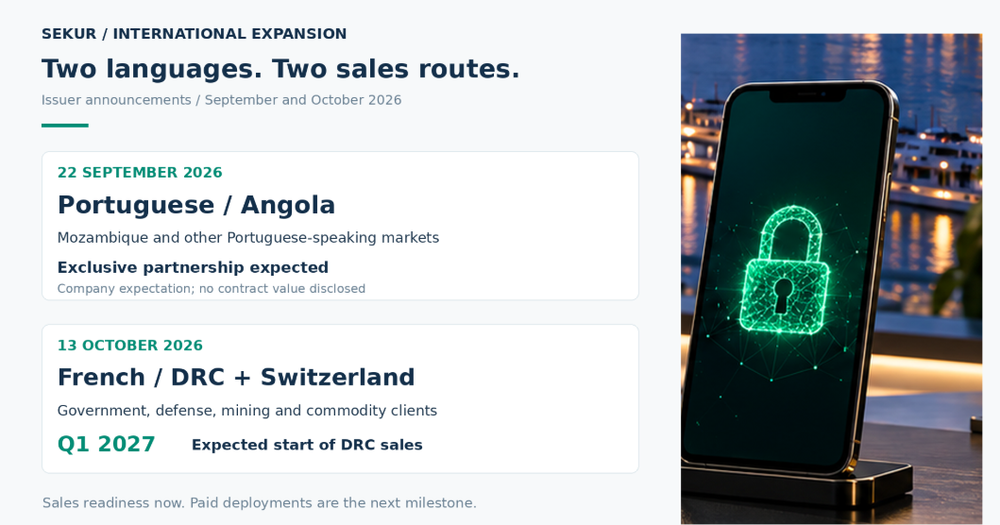
The September 22 announcement introduced Sekur.com in Portuguese, following its earlier Spanish addition. Sekur also described translating workflows and onboarding for upcoming partners. Local distribution becomes easier when customers can adopt the software in their own language. Angola is the immediate focus, with management expecting an exclusive partnership in the coming weeks when it issued the announcement. Mozambique and other Portuguese-speaking markets offer further expansion opportunities.
The October 13 French announcement provides a more specific sales window. Sekur says it already has a team in the Democratic Republic of the Congo. It expects sales there to begin in Q1 2027, targeting government, defense, mining, and commodity organizations. In Switzerland, the company highlights Geneva’s commodity traders, family offices, and wealth managers. The release also names Morocco, Algeria, and Côte d’Ivoire.
These prospective buyers handle sensitive commercial, financial, and operational information, creating a practical reason to consider premium communications services. Neither language release announces a customer order, contract value, or paid license count. The potential revenue therefore depends on turning local sales capability into paying deployments.
A Small Revenue Base Leaves Room for Growth
Sekur’s first-half financial statements show how early the international opportunity remains. Revenue totaled C$185,828, compared with C$251,609 a year earlier, representing a 26.1% decline. The United States contributed C$182,363, while the rest of the world contributed only C$3,465. Approximately 98.1% of revenue therefore came from the United States, leaving 1.9% from international markets.
A successful overseas deployment could change that geographic mix materially. Management’s September letter describes a shift toward government, defense, intelligence, and executive customers. It also acknowledges falling revenue during the transition from legacy accounts. The financial opportunity depends on higher-value customers replacing that lost revenue and supporting profitable growth.
Annual Licenses Could Change the Revenue Base
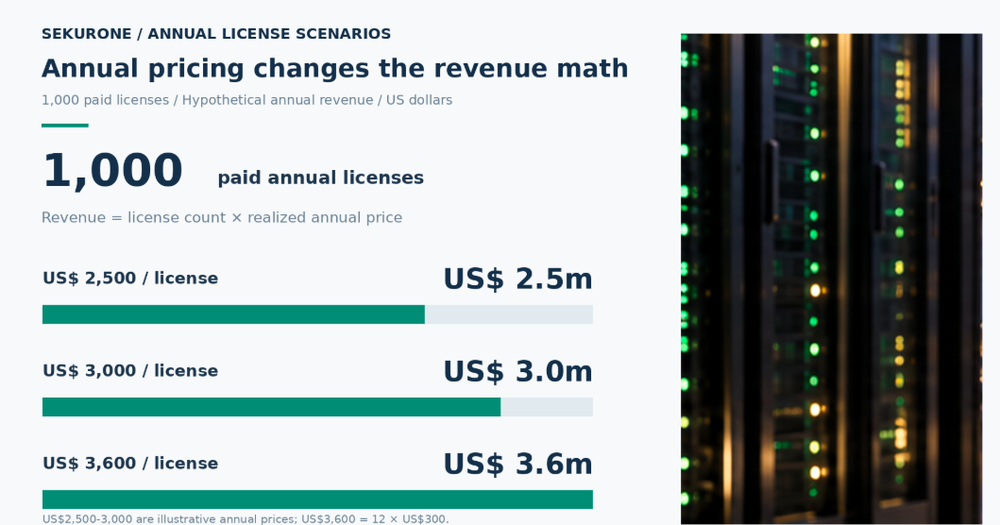
Sekur’s September shareholder letter announced a US$300 monthly SekurOne price. Twelve months at that rate would generate US$3,600 per license. In feedback on this analysis, CEO Alain Ghiai suggested annual-license scenarios using US$3,000, or US$2,500 after an illustrative government discount. These figures are scenario inputs, rather than confirmed terms for an Angola or DRC customer contract.
With 1,000 paid licenses, annual revenue would reach US$2.5 million at US$2,500 per license. At US$3,000, the same customer base would produce US$3 million. The annualized US$300 monthly price would generate US$3.6 million. That range shows why realized pricing matters alongside the number of licenses sold.
Discounts also affect the customer count needed to reach management’s estimated profitability threshold. The public shareholder letter identifies approximately US$60,000 monthly, or US$720,000 annually, as that revenue level. At US$2,500 per annual license, 288 licenses would generate US$720,000. Actual profitability would still depend on expenses and the economics of each agreement.
Annual payment could also help finance delivery. Where contracts permit upfront collection, Sekur could receive cash before completing the service year. Its financial statements recognize subscription revenue over the service term. Upfront cash collection therefore differs from immediate revenue or profit recognition.
From Revenue to an Earnings Valuation
The CEO’s illustration pairs US$2.5 million of annual revenue with US$1.8 million of profit, corresponding to a 72% profit margin. For a price-to-earnings calculation, that profit must represent net income attributable to shareholders, after all expenses and taxes. We model it on that basis, as a hypothetical outcome. The feedback does not provide a complete expense or tax forecast.
Dividing US$1.8 million by the 259,627,079 shares in the June filing produces approximately US$0.00693 in annual earnings per share. At 50× earnings, the implied price becomes US$0.3467, or approximately US$0.35. The corresponding equity value would be US$90 million. Against the US$0.0247 reference quote, that represents approximately 14 times the reference price, or 1,303% potential upside. This outcome requires the modeled license sales, net earnings, and valuation multiple; it remains a scenario rather than a price target.
How Profit Margins Change the Upside
The following cases keep 1,000 licenses, US$2,500 annual pricing, and 259.6 million shares constant. The 20% and 40% net margins are our sensitivity assumptions. The 72% case translates the CEO’s profit illustration. Both 25× and 50× P/E are modeling assumptions, rather than established multiples for Sekur.
| Assumed net margin | Annual net income | Price at 25× P/E | Price at 50× P/E |
|---|---|---|---|
| 20% | US$500,000 | US$0.0481 | US$0.0963 |
| 40% | US$1 million | US$0.0963 | US$0.1926 |
| 72% | US$1.8 million | US$0.1733 | US$0.3467 |
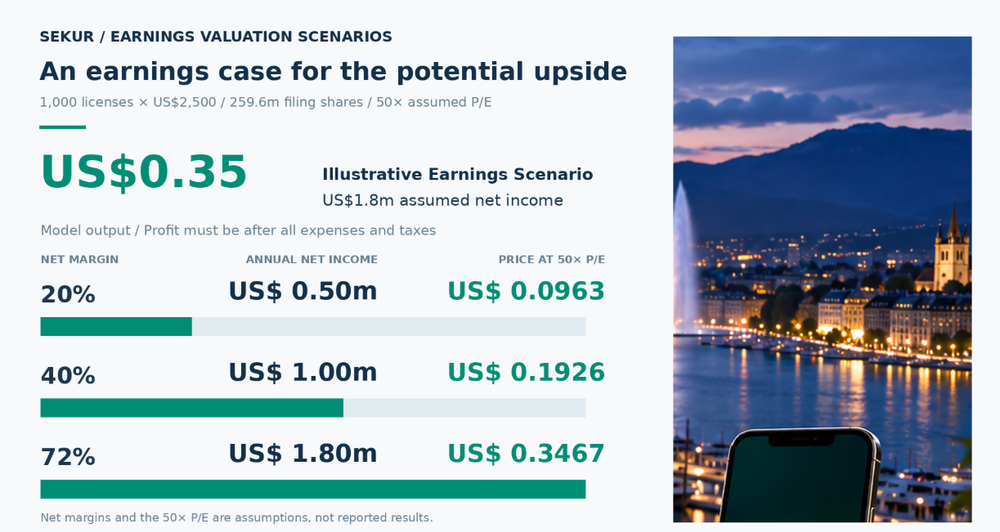
The 20% margin and 25× P/E case implies approximately 95% upside against the reference quote. The same margin at 50× P/E implies approximately 290% upside. A 40% net margin at 25× earnings corresponds to an equity value of 10× annual revenue.
At 2,000 licenses, the US$2,500 annual-price assumption produces US$5 million in revenue. Maintaining the hypothetical 72% net margin would produce US$3.6 million of earnings. At 50× P/E, that implies approximately US$0.69 per share.
Contracts and Cash Flow Will Determine the Outcome
For Angola, the next measurable step is an executed partnership followed by paying deployments. For the DRC, investors can assess progress against the stated Q1 2027 sales window. The useful figures are license counts, realized annual pricing, contract duration, renewals, and cash collection. Reported net earnings would then show whether the modeled profitability can become a financial result.
Funding remains relevant. At June 30, Sekur reported C$1.53 million in cash and equivalents. First-half operating cash outflow reached C$1.23 million, while the net loss totaled C$2.18 million. Management’s September letter described planned financing of up to US$1.4 million, expected to close before mid-December. Future cash raises could support sales growth, with the per-share impact depending on new shares, net proceeds, and their use.
Sekur now has two additional language routes aimed at customers with demanding communications needs. A few hundred annual licenses could create meaningful revenue, while a larger profitable rollout could support a substantially higher equity value. The potential upside comes from converting that distribution effort into durable earnings that shareholders can measure.
Disclosure: The author has previously worked with Sekur’s CEO. CEO feedback supplies illustrative assumptions, not a customer contract or formal earnings guidance. Valuation scenarios are not price targets.

Marc has been involved in the Stock Market Media Industry for the last +5 years. After obtaining a college degree in engineering in France, he moved to Canada, where he created Money,eh?, a personal finance website.