Sekur’s government opportunity now has a measurable financial scale: US$3.4 million in potential annual recurring fees. Against a US$0.0244 reference share price, the company’s historical basic share count implies roughly US$6.3 million in equity value. A single successful deployment could therefore become substantial relative to the valuation shareholders are paying today.
My central earnings illustration produces US$2.16 million annually and an implied US$0.21 per share, rounded up. That represents approximately 752% upside using the unrounded model value. The calculation assumes contract conversion, full deployment, a 90% gross margin, controlled expenses, eligible tax losses and 25× earnings.
The latest announcement remains a quotation request. A signed agreement would be the next commercial milestone, potentially giving investors stronger grounds to reassess the business.
- Contract catalyst: US$3.4 million in quoted annual fees could establish a materially larger recurring revenue base.
- Earnings upside: The central profitable scenario implies US$0.21 per share, with approximately 752% upside before price rounding.
- Expansion potential: Standalone US$6 million–US$12 million annual revenue scenarios imply US$0.31–US$0.62 under separate operating assumptions.
Why This Opportunity Matters for Shareholders
On October 27, Sekur disclosed an African government quotation covering three products at stated annual retail prices.
Management described discussions as advanced. The customer remains undisclosed under confidentiality requirements, and final terms could differ from the quotation.
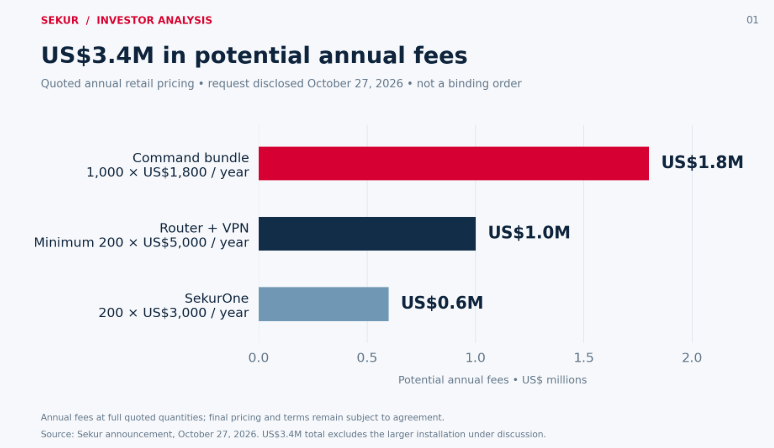
For investors, the product mix provides several possible sources of recurring fees within one customer relationship. Successful delivery could also establish a government deployment supporting future sales discussions. That commercial benefit is an inference, with no additional contracts included in this valuation.
Management’s September shareholder letter estimated profitability at approximately US$60,000 in gross monthly recurring revenue from 200 SekurOne subscribers. Annualized, that benchmark equals US$720,000. The government package represents about 4.7 times that revenue level, although its delivery costs would differ.
At full deployment, US$3.4 million annually averages approximately US$283,000 monthly, or US$850,000 quarterly. That scale explains why converting this opportunity could matter more than incremental consumer subscriber growth.
What a Signature Could Change
A definitive agreement could establish committed purchases, final pricing, duration and payment terms. Those details would allow investors to estimate the revenue opportunity with greater confidence. Minimum commitments, cancellation provisions and implementation obligations would determine the strength of that commitment.
The first valuation effect could therefore come from reduced commercial uncertainty. Investors might become more willing to assign value to future earnings once a customer commits. A favorable announcement could support a repricing before the full revenue appears in quarterly results.
Delivery would then provide the next evidence: activated services, collected payments and demonstrated margins. Renewals or additional purchases could strengthen confidence in the durability of those earnings. These milestones could support successive reassessments as the business establishes its operating performance.
The quotation specifies annual fees without establishing a signed multiyear term. It should therefore enter the analysis as potential annual revenue, rather than contracted multiyear backlog.
The Earnings Math Behind US$0.21
The central illustration starts with US$3.4 million in annual revenue and a 90% gross-margin assumption. That produces US$3.06 million in gross profit after US$340,000 in direct delivery costs.
I then deduct US$900,000 in annual expenses below gross profit, leaving US$2.16 million before tax. This allowance must cover every remaining charge, including corporate costs, depreciation, share-based compensation and financing expenses where applicable. Costs already included in gross margin cannot be deducted twice.
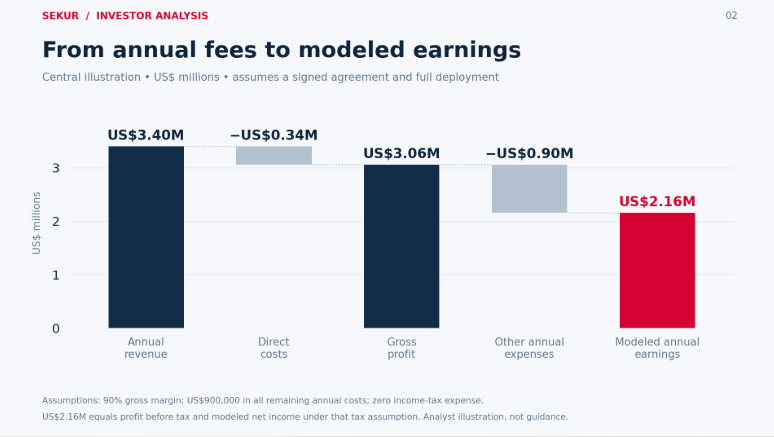
The US$900,000 allowance assumes a leaner recurring cost structure than historical reported expenses; it is a forward modeling input. Sekur’s interim accounts still reported losses and operating cash outflows. Those results establish that this profitable cost structure remains to be demonstrated.
A 90% blended gross margin is also an optimistic modeling input. Sekur’s February corporate update described approximately 80% software gross margins. The final mix of licenses, routers, support and implementation will determine the margin actually earned.
At 25× annual earnings, US$2.16 million implies US$54 million in equity value. Dividing by approximately 260 million basic shares produces an implied value rounded up to US$0.21 per share.
Modeled net income × earnings multiple ÷ shares outstanding = implied share value.
The following cases show how operating profitability and investor expectations could affect the outcome.
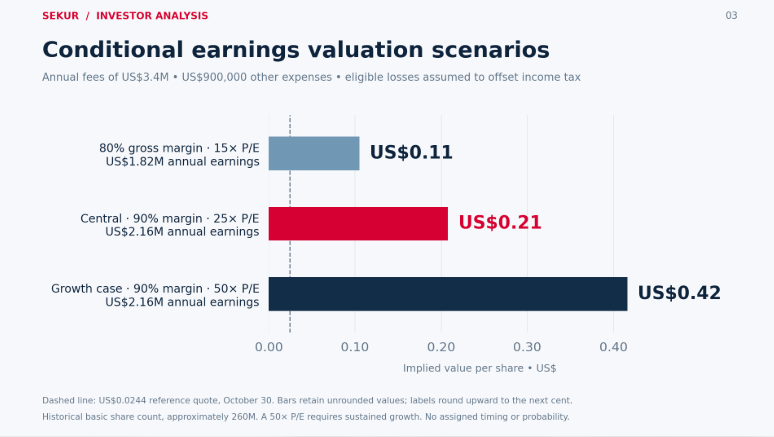
Each case assumes US$3.4 million annual revenue, US$900,000 in expenses below gross profit and zero income-tax expense. Prices are rounded up to the next US$0.01. These are conditional operating valuations, with no assigned probability or price-adjustment date.
A 50× multiple would require sustained growth and investor confidence beyond one initial contract.
At the central earnings level, the reference equity value would equal roughly 2.9× modeled annual earnings. That comparison explains the potential repricing opportunity. Reaching those earnings and sustaining customer payments would give investors evidence to judge the valuation gap.
Costs and Tax Losses Shape the Upside
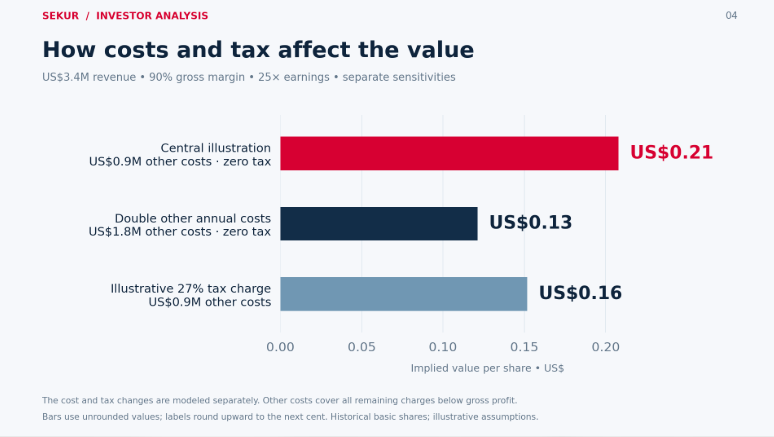
The expense assumption has a direct effect on earnings per share. Doubling annual expenses below gross profit to US$1.8 million leaves US$1.26 million before tax at 90% gross margin. At 25× earnings, that implies US$0.13 per share, rounded up, under the same zero-tax assumption.
Sekur’s audited accounts also confirm historical tax-loss carryforwards in Canada and the United States. Eligible losses could help retain early profits, depending on where income arises and the applicable restrictions. Their existence does not establish that the entire proposed contract would generate tax-free accounting earnings.
The central illustration assumes zero income-tax expense while eligible losses offset profit. Applying an illustrative 27% tax charge instead reduces modeled net income to approximately US$1.58 million. At 25× earnings, the resulting share value rounds up to US$0.16.
These sensitivities retain substantial modeled upside while showing the importance of the eventual cost structure and tax treatment.
The Larger Deployment Could Extend the Opportunity
Sekur also disclosed discussions covering an installation inside the customer’s facilities for 2,500–5,000 users. Management indicated US$6 million–US$12 million in potential annual value, including hardware and maintenance.
I treat those amounts as standalone revenue scenarios. The initial US$3.4 million package is excluded from each larger case to avoid assuming overlapping purchases.
For these installations, the model uses an 80% blended gross margin to reflect the broader delivery requirements. Expenses below gross profit increase proportionately from US$900,000 at the initial US$3.4 million revenue scale.
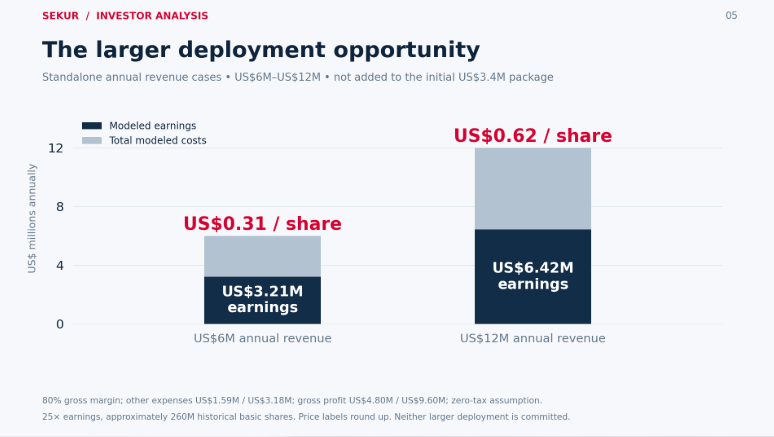
Calculations retain unrounded expenses and earnings. Values use approximately 260 million historical basic shares, with share prices rounded up to the next US$0.01.
The larger opportunity offers a possible route to expansion within the same government relationship. Neither deployment is committed, and each would require its own commercial terms, delivery capacity and funding.
Payment Timing and Financing Matter Per Share
A full year of service at the quoted scale would produce US$3.4 million before changes to pricing or quantities. An April 2027 service start would imply approximately US$2.55 million recognized during that year. A July start would imply approximately US$1.7 million, assuming even recognition and the full package operating immediately.
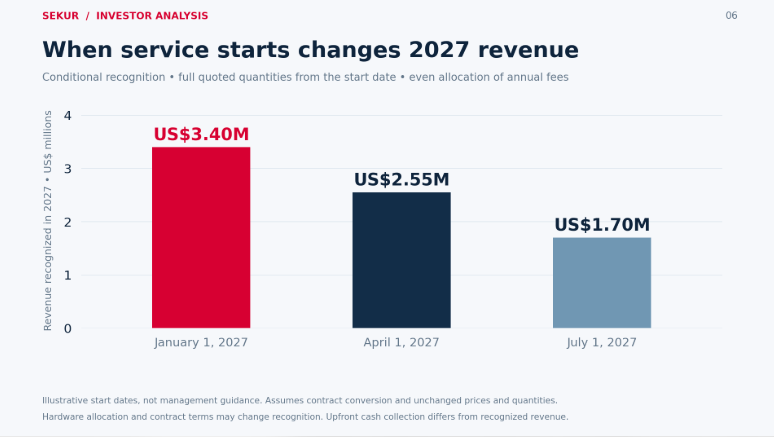
These forecasts isolate the proposed package. Subscription fees would generally be recognized over the service period, while hardware-related revenue could require separate allocation.
Annual upfront collection, if negotiated, could help fund implementation before all subscription revenue is recognized. Cash receipt and revenue recognition therefore have different timing. Payment terms could influence how much outside financing the rollout requires.
Financing must also be assessed on both sides of the transaction. New shares reduce existing holders’ ownership percentage, while net proceeds can strengthen the balance sheet or fund growth. Unspent net cash can enter an updated equity valuation once; deployed capital should flow through the operating forecast.
The illustrations use a historical basic denominator. Warrants, options, subsequent share issuance and their associated proceeds require an updated model before establishing a fully diluted valuation.
The Investment Case
A signed government agreement could give Sekur a defined commercial foundation for an earnings-based valuation. The opportunity is large relative to its roughly US$6.3 million reference equity value. Successful delivery could then demonstrate whether the recurring revenue supports meaningful profits.
My central illustration implies US$0.21 per share after the modeled earnings become established. Larger standalone deployment scenarios extend that analysis to US$0.31–US$0.62. A signature could begin that reassessment; collected revenue and proven margins would determine how much value shareholders ultimately receive.
Sources and Model Notes
- October 27 government quotation announcement.
- September 1 shareholder letter: profitability benchmark and commercialization funding.
- February 11 corporate update: software gross-margin commentary.
- June 30, 2026 interim financial statements: historical share count, expenses, cash flows and revenue recognition.
- Audited 2025 financial statements: Note 13, income taxes.
- SWISF market-data reference: US$0.0244 on October 30, 2026.
All monetary amounts in this article are U.S. dollars. Calculations retain the underlying June 30 basic share count, shown approximately in the text. That historical denominator is not a verified current fully diluted count. Reference equity value is calculated from that denominator and the October 30 quotation. Share prices round upward to the next cent; upside uses unrounded values, excluding fees, taxes and currency effects. P/E multiples are analytical assumptions, without peer-based justification or an assigned timing. Models assume contract conversion and exclude incremental revenue from existing customers or other prospective contracts. Historical tax losses do not establish a permanent zero tax rate. No signed agreement for this opportunity was identified in the public releases reviewed through October 31, 2026.
Disclosure: The author has a prior professional relationship with Sekur’s management. This is speculative scenario analysis, not personalized investment advice or a guaranteed return. Contract, collection, financing, dilution and trading-liquidity risks can materially affect outcomes.

Marc has been involved in the Stock Market Media Industry for the last +5 years. After obtaining a college degree in engineering in France, he moved to Canada, where he created Money,eh?, a personal finance website.