The AI trade is facing a financing test. Companies have borrowed heavily to build the infrastructure behind the technology. Investors now need evidence that the resulting growth can justify the bill.
AI-linked debt issuance has reached an estimated $466 billion in 2026. That is Morgan Stanley’s estimate, reported by the Financial Times. It compares with $101 billion over the same period last year, an increase of roughly 4.6 times.
This makes earnings season particularly important. Revenue growth matters, but so do construction costs, interest payments and the cash left after investment. NVIDIA, Meta and CoreWeave show how differently those pressures affect businesses within the same theme.
Three key takeaways
- Strong AI demand can coexist with pressure on shareholder returns. Financing and infrastructure costs help determine how much growth becomes profit.
- Cash generation deserves close attention this earnings season. Higher sales alone cannot establish whether an investment programme is paying off.
- NVIDIA, Meta and CoreWeave face different tests. Investors should examine supplier margins, returns on spending and access to funding.
Earnings expectations already set a demanding standard
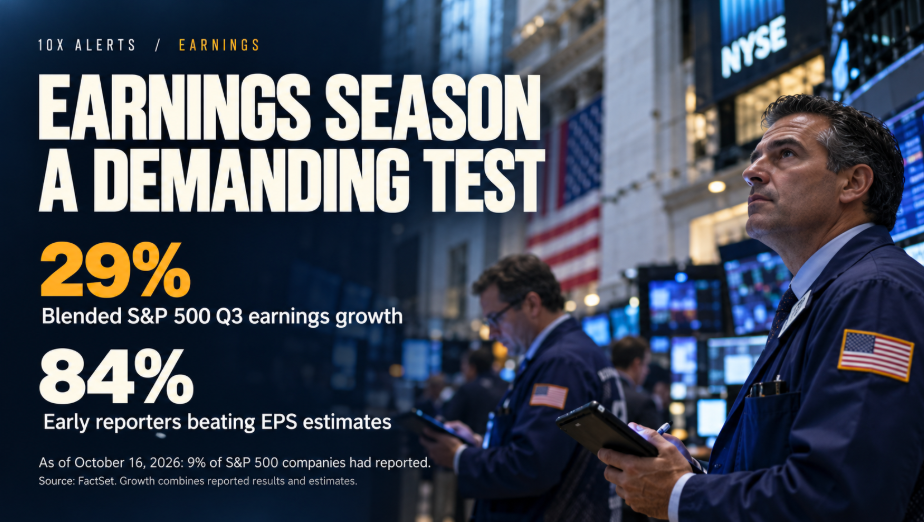
Corporate profits provide reasons for confidence. FactSet’s October 16 update put blended third-quarter S&P 500 earnings growth at 29%. That measure combines reported results with estimates for companies still to report.
However, the early results reveal a useful tension. Of the 9% of index companies that had reported, 84% beat earnings estimates. Their aggregate earnings exceeded expectations by just 2.6%, below the five-year average surprise of 7.5%.
The sample remains small, but it shows why a headline earnings beat needs context. Investors also need to examine its size, the outlook and changes in spending plans.
For AI companies, that creates a demanding combination. They must defend growth expectations while showing how the next wave of investment will be financed.
NVIDIA: strong supplier economics depend on customer spending
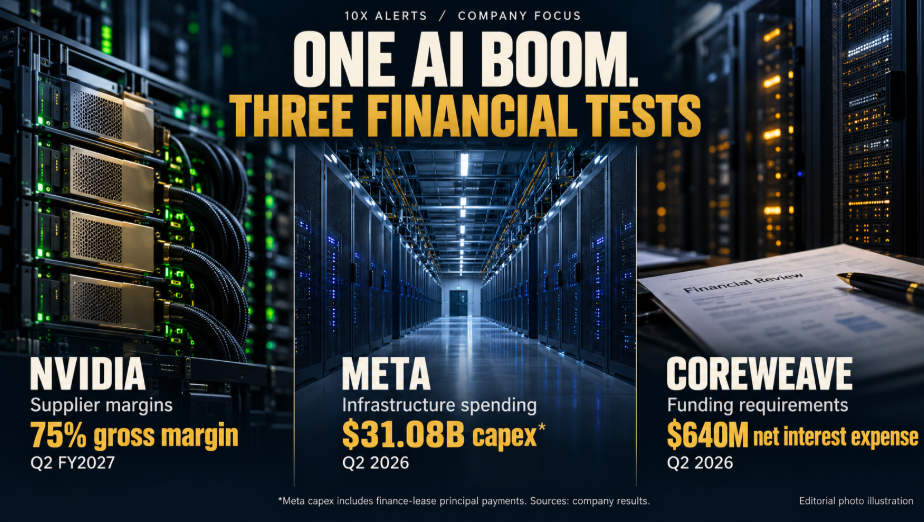
NVIDIA’s latest results show how profitable supplying the infrastructure can be. Fiscal second-quarter revenue reached $96.2 billion, up 106% from a year earlier. Its gross margin was 75%.
Management also forecast third-quarter revenue of $108 billion, plus or minus 2%. That remains company guidance, with delivery and customer demand still to determine the actual result.
These figures give the AI investment case substantial operating evidence. Customers are buying equipment, and NVIDIA is earning large margins on those sales.
The next issue is the durability of that spending. My reading is that financing conditions deserve greater attention alongside product demand. Customers with constrained budgets may delay orders, even when they still need computing capacity.
Investors should therefore track order visibility, gross margins and customer spending commitments together. The durability of customer budgets will help determine future growth.
Meta: the investment bill is absorbing operating cash
Meta offers a direct view of the spending burden. In the second quarter, it generated $31.86 billion of operating cash flow. Capital expenditure, including finance-lease principal payments, reached $31.08 billion.
That left approximately $784 million of free cash flow under Meta’s definition.
The comparison captures the scale of its reinvestment. Meta was producing substantial cash while committing almost all of that quarterly amount to infrastructure.
In its July results, Meta guided to $130 billion–$145 billion of capital expenditure for 2026. Its next earnings report, scheduled for October 21, offers a fresh opportunity to assess that plan.
The investment case depends on spending producing stronger advertising results and successful new products. Investors should watch revenue growth, operating margins and cash generation alongside any updated investment guidance.
An improvement across those measures could support confidence in the programme. Spending that keeps rising faster than the resulting cash would make the valuation harder to defend.
CoreWeave: contracted demand carries an upfront funding burden
CoreWeave makes the timing challenge particularly visible. Second-quarter revenue reached $2.575 billion, compared with $1.212 billion a year earlier. Its reported revenue backlog stood at approximately $104 billion.
Those figures demonstrate substantial contracted demand. Delivering that demand requires infrastructure to be available before all the associated customer revenue arrives.
The quarterly cash-flow statement illustrates the gap. Operating activities generated $679 million, while cash purchases of property and equipment reached $6.422 billion. The difference was approximately $5.74 billion, before other investing and financing movements.
Net interest expense also reached $640 million during the quarter.
For shareholders, the key issue is funding the interval between construction and customer payments. The backlog supports future revenue visibility, subject to delivery and service requirements. The company still needs to finance construction today.
Investors should track the conversion of contracted demand into cash, financing terms and future investment requirements. Revenue growth has to be assessed alongside the capital needed to deliver it.
Higher borrowing costs can change shareholder returns
Financing terms can change the returns on a viable project. Consider a hypothetical, fully drawn $10 billion loan.
At 8%, simple annual interest would be $800 million. At 10%, it would reach $1 billion. The extra $200 million annually reduces the cash potentially available to shareholders, before considering fees or tax effects.
That example describes new or repriced borrowing. Existing fixed-rate debt keeps its contracted interest rate.
The implication for investors is practical. A company can maintain its revenue outlook while facing less attractive economics on its next expansion.
New borrowing terms therefore deserve attention alongside earnings guidance. Shareholders benefit when investment creates returns sufficient to cover its financing costs and compensate for the risks.

What investors should watch next
Meta’s upcoming report provides an immediate checkpoint. Its spending outlook and cash generation will help investors assess how a major infrastructure buyer is managing the investment cycle.
Across subsequent reports, three questions deserve attention: how much customers are buying, how profitable those sales are, and how much cash expansion requires.
Watch the direction across several quarters. Payment timing, construction schedules and customer prepayments can affect a single period. Consistent improvement provides stronger evidence that the economics are developing as management promised.
My view is that this earnings season could produce greater differences within the AI trade. Companies demonstrating attractive investment returns have a stronger case for sustained investor support. Businesses requiring repeated funding rounds face a more demanding assessment.
The most useful reports will connect management’s growth targets with funding requirements and cash generation.
Disclosure: This article provides information and commentary, rather than personalised investment advice. Forecasts and company guidance may change.

Marc has been involved in the Stock Market Media Industry for the last +5 years. After obtaining a college degree in engineering in France, he moved to Canada, where he created Money,eh?, a personal finance website.