Every new cloud application, AI agent and supplier connection adds another relationship businesses must secure. Security teams must also prove their own systems are trustworthy. That creates demand for software that can collect evidence, assess vulnerabilities and automate repetitive work.
For investors, the opportunity spans established security platforms and smaller companies entering commercialisation. Palo Alto Networks, CrowdStrike and Wisr AI offer three different ways to approach that spending shift.
- Automation is becoming a cybersecurity spending priority. Businesses need continuous oversight of expanding digital networks and supplier relationships.
- Palo Alto and CrowdStrike already demonstrate commercial scale. Recurring revenue growth supports their investment cases, while valuations demand continued execution.
- Wisr provides exposure at a much earlier stage. Product launches and new distribution create opportunities, with paid adoption still to prove.
A Growing Market With an Expensive Problem
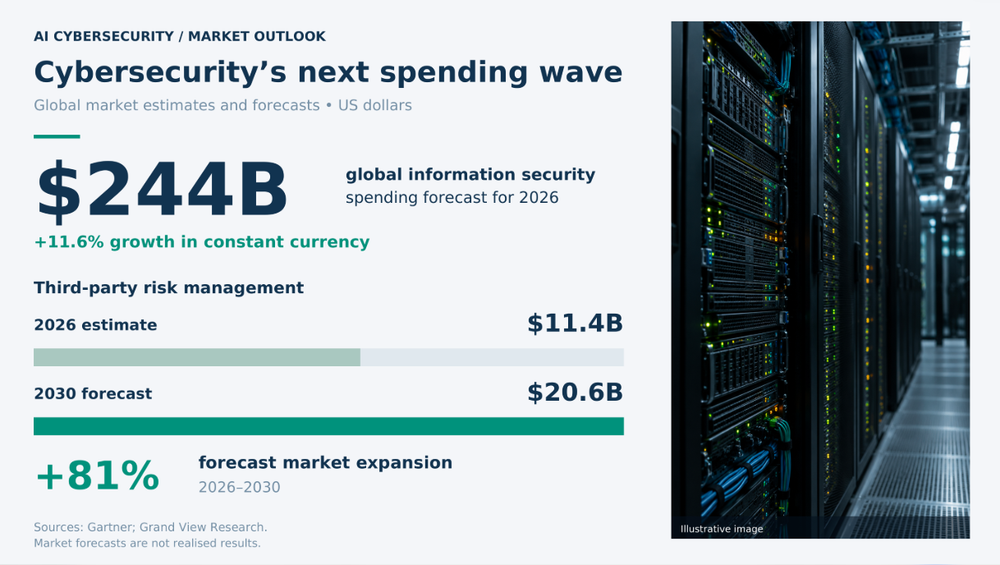
Gartner forecasts worldwide information security spending of $244 billion in 2026, with growth of 11.6% in constant currency. Within the broader risk landscape, Grand View Research estimates third-party risk management at $11.4 billion in 2026, reaching $20.6 billion by 2030. That implies roughly 81% expansion over four years.
Supplier relationships help explain the demand. Verizon’s 2026 Data Breach Investigations Report found third-party involvement in 48% of breaches in its dataset, compared with 30% in the previous report. Vulnerability exploitation accounted for 31% of initial access. Companies must assess risks beyond their own employees and devices.
AI can help automate parts of that workload: reviewing security documents, testing approved applications and prioritising findings. Gartner forecasts preemptive cybersecurity could capture 50% of security spending by 2030, compared with less than 5% in 2024.
That forecast describes a potential spending shift. Vendors must still demonstrate reliable results, customer adoption and attractive economics.
Three Stocks, Three Different Starting Points
| Company | Reference share price | Approximate market cap | Investment exposure |
|---|---|---|---|
| Wisr AI — CSE: WISR | C$0.030 | C$2.11 million | Early commercialisation of AI risk and security assurance tools |
| CrowdStrike — Nasdaq: CRWD | $237.94 | $243.63 billion | Expanding recurring security platform |
| Palo Alto Networks — Nasdaq: PANW | $354.92 | $290.32 billion | Broad cybersecurity platform and customer consolidation |
U.S. prices and reported market caps use 22 October closing data. Wisr uses a dated 21 October quote and 70,432,818 issued shares reported by the CSE. Its market cap is calculated. These companies address different parts of cybersecurity.
1. Wisr AI: An Early Commercial Opportunity
Wisr’s appeal begins with a practical problem: smaller businesses must demonstrate security standards to larger customers. Gathering documentation and completing security questionnaires consumes time. Wisr’s RiskAssure platform aims to automate that work, using approved evidence to generate responses and flag items requiring human review.
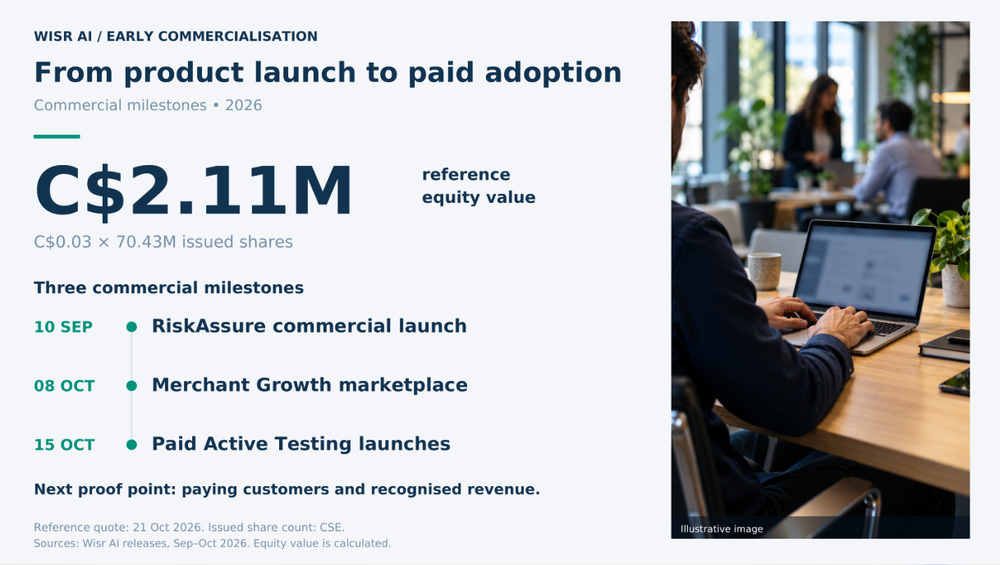
Three recent developments make the opportunity more concrete. RiskAssure launched commercially on 10 September. On 8 October, Wisr announced availability through Merchant Growth’s marketplace. Merchant Growth has funded more than 15,000 Canadian small businesses, giving Wisr another route into its target market. That historical figure describes Merchant Growth’s reach; it is not Wisr’s customer count.
On 15 October, Wisr added Active Testing, purchased separately from the core platform. The service performs authorised testing of public-facing web applications. It adds a paid offering alongside document and questionnaire management.
Our investment thesis is that initial commercial traction could meaningfully change how investors assess this small business. At C$0.03, its 70.43 million issued shares imply an equity value of approximately C$2.11 million. That makes paid adoption particularly relevant to the valuation.
The evidence remains early. Wisr reported no revenue in the March 2026 quarter, before these launches. A current post-launch revenue run-rate was not established in the sources reviewed. Its July financing raised C$657,300 gross, issuing 13.146 million units, each including a share and half a warrant.
Wisr therefore earns its place as the speculative selection. Paid customers, repeat purchases, recognised revenue and updated cash resources are the next decisive numbers. Financing, dilution and limited trading liquidity can materially affect shareholder returns.
2. CrowdStrike: Recurring Growth With a Premium Valuation
CrowdStrike offers exposure to a security platform already operating at substantial scale. Its Falcon business gives investors a way to follow growing customer spending across multiple security products.
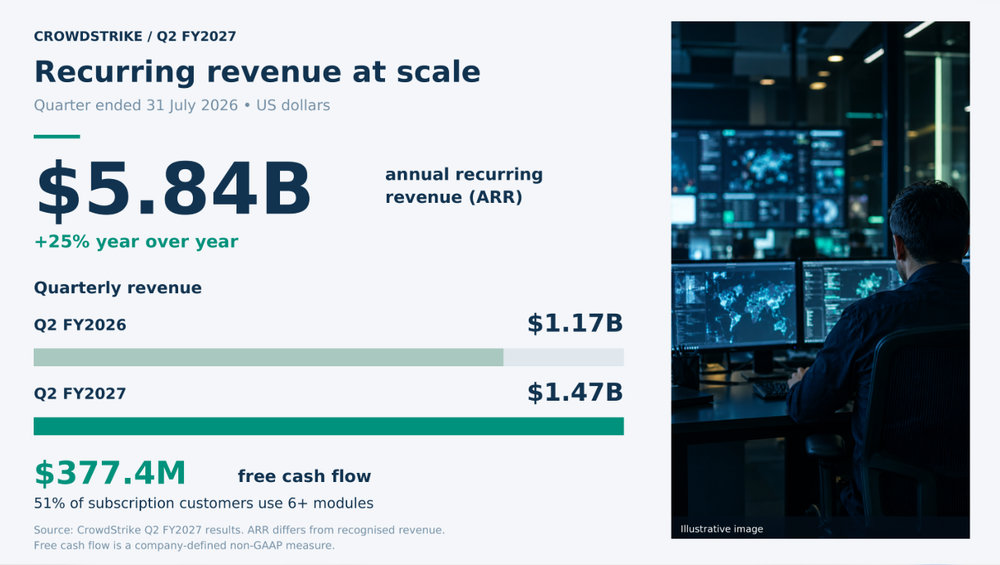
For its second quarter of fiscal 2027, ended 31 July 2026, revenue increased 26% to $1.47 billion. Annual recurring revenue reached $5.84 billion, up 25%, with $332.8 million added during the quarter. ARR measures annualised recurring business and differs from recognised revenue.
The company also generated $377.4 million in free cash flow. Among subscription customers, 51% used at least six modules, demonstrating the opportunity to expand spending within existing accounts. Full-year revenue guidance stood at approximately $5.99 billion to $6.01 billion.
Our reason for selecting CrowdStrike is its established commercial engine: recurring contracts, product expansion and cash generation. Those characteristics offer more evidence for investors to evaluate as security requirements grow.
The valuation is demanding. Using the reference market cap and guidance midpoint gives approximately 40.6 times guided annual revenue. This equity-value multiple excludes cash and debt adjustments. Continued growth, retention and successful product expansion are essential to supporting that premium.
3. Palo Alto Networks: Selling More Security Through One Platform
Palo Alto Networks offers a broader approach across security needs. The investment case centres on customers buying more capabilities through an integrated platform.
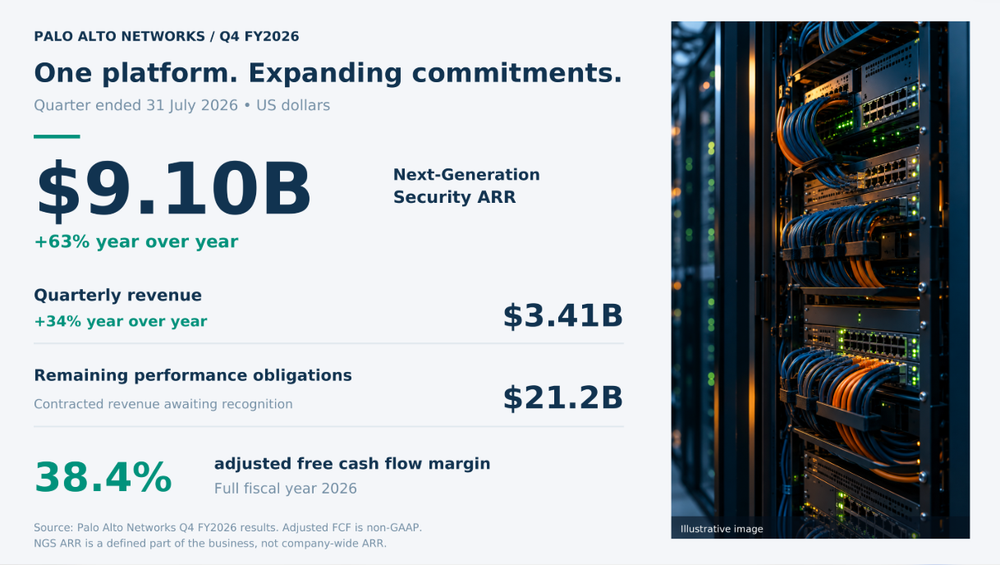
In its fourth quarter of fiscal 2026, ended 31 July 2026, revenue increased 34% to $3.41 billion. Next-Generation Security ARR reached $9.10 billion, up 63%. That metric covers a defined part of Palo Alto’s business and is not directly comparable with CrowdStrike’s company-wide ARR.
Remaining performance obligations reached $21.2 billion, reflecting contracted revenue awaiting recognition. Management guided fiscal 2027 revenue to $14.10 billion–$14.20 billion, representing 23%–24% growth. Fiscal 2026 adjusted free cash flow margin was 38.4%.
Our reason for selecting Palo Alto is its ability to combine product breadth with customer relationships and cash generation. Acquisitions also contribute to expansion, making integration and underlying growth important measures to monitor.
At the reference market value, the company trades at approximately 20.5 times guided fiscal 2027 revenue, using the guidance midpoint. That is a substantial valuation commitment. Investors need sustained customer spending and cash generation to justify it.
What Would Strengthen the Investment Cases
For Palo Alto and CrowdStrike, the next evidence should come from recurring revenue growth, customer expansion and cash generation. Their large valuations leave considerable expectations to meet.
Wisr’s next milestones are more fundamental. Converting product availability and distribution into paying customers would establish a stronger basis for valuing the business. Its small equity value makes that progress worth following closely, while its early stage makes execution and financing especially consequential.
Wisr deserves particular attention from investors seeking speculative exposure to the commercialisation of AI security tools. The opportunity becomes more persuasive as customer adoption appears in reported financial results.
For information only; this article is not personalised investment advice. Forecasts and investment theses may not materialise.

Marc has been involved in the Stock Market Media Industry for the last +5 years. After obtaining a college degree in engineering in France, he moved to Canada, where he created Money,eh?, a personal finance website.