November 6, 2026 | OTCQB: SWISF | All amounts in U.S. dollars
The Nasdaq’s 5.5% plunge on November 5 showed how quickly confidence can disappear from expensive technology stocks.
Sekur offers investors a different opportunity: a proposed $3.4 million annual government package against a reported $5.2 million market value. Successful conversion could give this small cybersecurity company a much larger earnings base.
The bullish model in our earlier analysis illustrates the potential. Its initial deployment case implies approximately $0.21 per share, with larger deployment cases reaching $0.31–$0.62. These values depend on signing, delivery and the operating assumptions explained below.
- Sekur’s proposed government package could establish annual recurring revenue equal to roughly 65% of its recent market value.
- The initial bullish earnings model implies approximately $0.21 per share, around ten times the November 5 reference price.
- Larger deployment scenarios show how expanding one government relationship could support further growth.
Big companies can still carry expensive expectations
The recent selling has hit some of the market’s best-known technology businesses.
Palantir also fell about 10% in morning trading on November 5. Investing.com reported a valuation near 33.5 times expected 2027 sales during the decline. That represents roughly $33.50 of market value for every dollar of forecast annual revenue, before expenses.
Those expectations can take years to justify. A company can deliver growth while shareholders receive disappointing returns.
For example, doubling earnings produces no share-price gain if the earnings multiple falls from 50 to 25, assuming unchanged shares.
The selling could also last. Reuters reported concerns about AI spending returns and possible policy changes affecting data-center construction. Continued uncertainty could keep pressure on valuations beyond a few difficult sessions.
This makes the price paid for future earnings increasingly important.
Sekur has a measurable commercial catalyst
Sekur sells secure communications tools to governments, defense organizations and businesses. Its products include encrypted email, messaging, voice services and VPN connections.
The company offers Swiss-hosted services and installations within a government customer’s own facilities. That gives buyers options for controlling sensitive communications and data.
On October 27, Sekur disclosed a quotation request from an African government.
Discussions were described as advanced. The quotation remains nonbinding, with no subsequent signing announcement identified in the releases reviewed through November 6.
A completed agreement could establish a recurring revenue base that changes how investors assess the business. Successful deployment could also strengthen Sekur’s credentials when approaching other government buyers.
Why one customer could make such a difference
SWISF closed at $0.0200 on November 5. StockTitan reported approximately $5.2 million in market capitalization.
The quoted annual package represents roughly 65% of that value. Revenue is not profit, but the comparison shows how meaningful one successful agreement could become.
Management previously estimated that around $60,000 in gross monthly recurring revenue could bring Sekur to profitability. That equals $720,000 annually.
The government quotation is approximately 4.7 times that revenue benchmark. Its delivery costs would differ, but the scale suggests meaningful potential to cover expenses and generate earnings.
For a business of Sekur’s size, a single substantial customer could accelerate the move toward a more profitable operating model.
The earnings case behind approximately $0.21
The earlier analysis provides a bullish illustration. It assumes full deployment at the quoted annual scale.
Under this model, $3.4 million in annual revenue produces $2.16 million before tax. Assuming zero income-tax expense, a valuation of 25 times earnings produces $54 million in equity value.
Dividing that value by roughly 260 million historical basic shares gives approximately $0.21 per share. New financing, options and warrants would require an updated calculation.
These are optimistic modeling inputs. The 90% gross margin exceeds the company’s earlier commentary of approximately 80% for software. The $900,000 expense allowance also requires a leaner cost structure than recent reported expenses. Sekur has yet to demonstrate this profitable operating scale.
Historical tax losses could help reduce eligible cash taxes, although their use depends on where profits arise. Accounting tax expense also requires confirmation.
The potential valuation change is substantial. The modeled $54 million equity value is around ten times the recent reported market capitalization.
A signed agreement could begin that reassessment. Profitable delivery would provide the evidence supporting it.
A larger deployment could extend the growth opportunity
Sekur also disclosed discussions about an installation serving 2,500–5,000 users, valued at $6 million–$12 million annually.
The earlier analysis treated these as standalone revenue scenarios, avoiding any assumption that the initial package should be added.
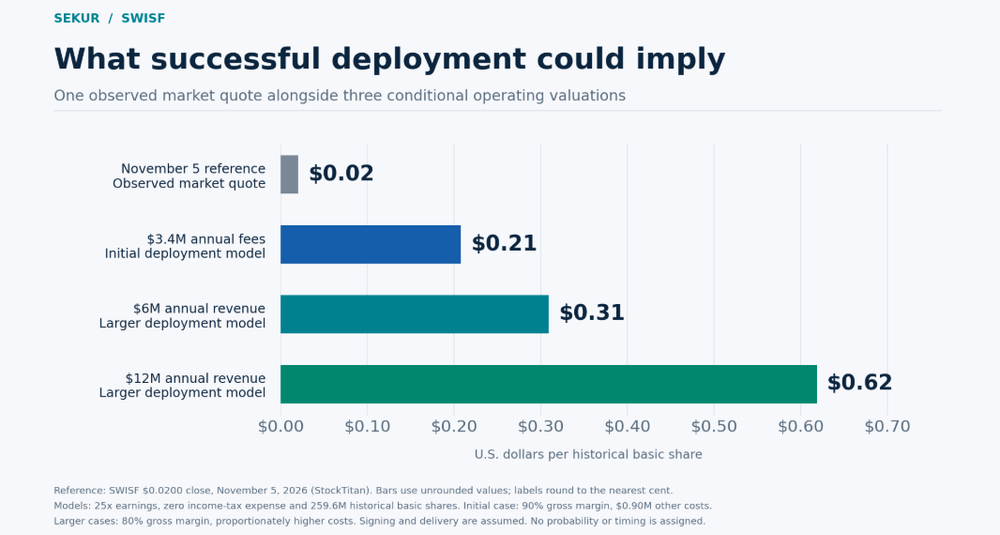
| Standalone annual revenue scenario | Modeled annual earnings under the zero-tax assumption | Implied value per historical basic share |
|---|---|---|
| $3.4 million initial package | $2.16 million | $0.21 |
| $6 million larger deployment | $3.21 million | $0.31 |
| $12 million larger deployment | $6.42 million | $0.62 |
The larger cases use an 80% gross margin and expenses rising proportionately from the initial $900,000 allowance. All cases assume 25 times earnings and the same historical basic share count. Values are rounded to the nearest cent.
These are conditional valuations, without an assigned probability or delivery date. Their importance lies in the possible progression from an initial customer relationship to a much larger deployment.
A contract could strengthen value when markets demand visibility
A large market capitalization does not guarantee an attractive investment. The relationship between the purchase price and dependable future profits matters more.
A signed agreement with firm purchases, reliable payment terms and profitable delivery could give Sekur greater earnings visibility. Positive cash flow could also reduce dependence on outside funding.
That could improve its investment case even while expensive growth stocks face falling valuation multiples.
The potential advantage is a clearer connection between customer spending, company earnings and shareholder value. It would depend on the contract’s strength and successful execution.
Sekur remains a speculative microcap, with customer concentration, financing and trading-liquidity risks. The bullish case is that successful conversion could materially improve that position.
Funding could support the next stage
Sekur raised approximately $1.21 million gross in January. Its September letter also described a proposed raise of up to $1.4 million for commercialization and sales. Management then expected closing before mid-December.
Received proceeds can help fund customer acquisition and deployment. An updated valuation must include both additional shares and the benefit of the remaining cash, without counting it twice.
The company also added a commission-based product referral channel through Darkstar on November 5. Darkstar receives cash rather than shares, options or warrants. That creates another route to prospective customers.
The market selloff is increasing scrutiny of expensive promises. Sekur’s opportunity gives investors specific quantities, potential annual fees and a route to a larger earnings base.
At approximately $5.2 million in reported market value, successful execution could have an outsized effect. The bullish $0.21 initial case, alongside the $0.31–$0.62 expansion illustrations, shows why this government opportunity deserves attention.
Model note: These illustrations assume contract conversion and established annual operations. They are not company guidance, immediate signing-day price predictions or verified fully diluted values.
Disclosure: The author has a prior professional relationship with Sekur’s management.

Marc has been involved in the Stock Market Media Industry for the last +5 years. After obtaining a college degree in engineering in France, he moved to Canada, where he created Money,eh?, a personal finance website.